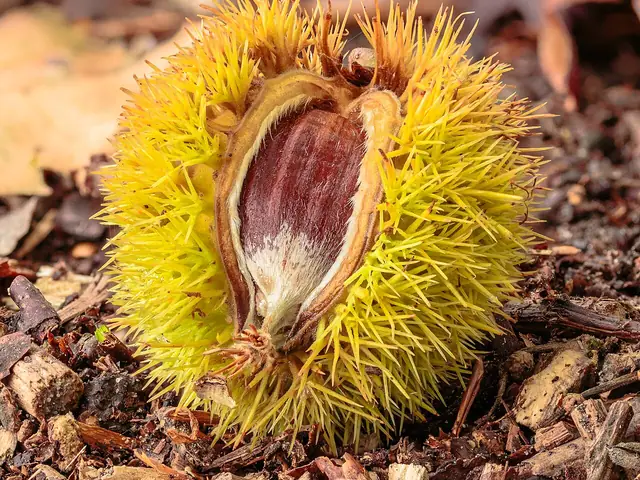
The sweet chestnut has long narrow leaves with toothed edges. It flowers late, in June, with long yellowish catkins. In October the spiny husks split and release edible chestnuts. The tree can live for several hundred years.
The sweet chestnut is related to beech and oak, not to the horse chestnut. For decades chestnut forests were destroyed by chestnut blight, a disease caused by a fungus. Today a form of the fungus weakened by a virus (hypovirulence) is spreading in many forests, so the trees are recovering. Chestnuts are pollinated by insects and wind.
Club observations
The club has not recorded this yet. The first record draws the first dot on the circle, and each year adds another.